
Mountain View, CA · 9 December 2024 — Google Quantum AI introduced Willow, a 105-qubit superconducting processor that achieved a milestone the quantum computing community has pursued for nearly three decades: quantum error correction operating below the surface code threshold. The results, published in Nature on 9 December 2024, demonstrate that as the error-correcting code is scaled up — using more physical qubits to encode a single logical qubit — the logical error rate decreases exponentially. This is the first time this property has been shown experimentally on a superconducting quantum processor.
The achievement addresses what has long been considered the central obstacle to useful quantum computing. Quantum bits (qubits) are extraordinarily fragile, losing their quantum state in fractions of a second due to thermal noise, electromagnetic interference, and other environmental perturbations. Error correction schemes, which encode a single robust "logical" qubit across many noisy "physical" qubits, have been theorised since the mid-1990s. But for these schemes to work, the physical error rate must fall below a critical threshold — a point at which adding more qubits helps more than it hurts. Willow is the first superconducting chip to cross that line.
The Below-Threshold Milestone
Google's research team, led by Hartmut Neven and Julian Kelly, tested surface codes of increasing size on the Willow processor. They scaled the code from a 3×3 array of physical qubits (encoding one logical qubit with distance-3) to 5×5 (distance-5) and 7×7 (distance-7) configurations. At each step, the logical error rate dropped by a factor of approximately two, confirming the exponential suppression predicted by threshold theory.
This result matters because it proves that the surface code — the leading candidate for practical quantum error correction — is not merely a theoretical construct. It can be physically realised and scaled on real hardware. Before Willow, experiments had struggled to reach the threshold; adding more qubits often introduced more errors than the correction scheme could handle.
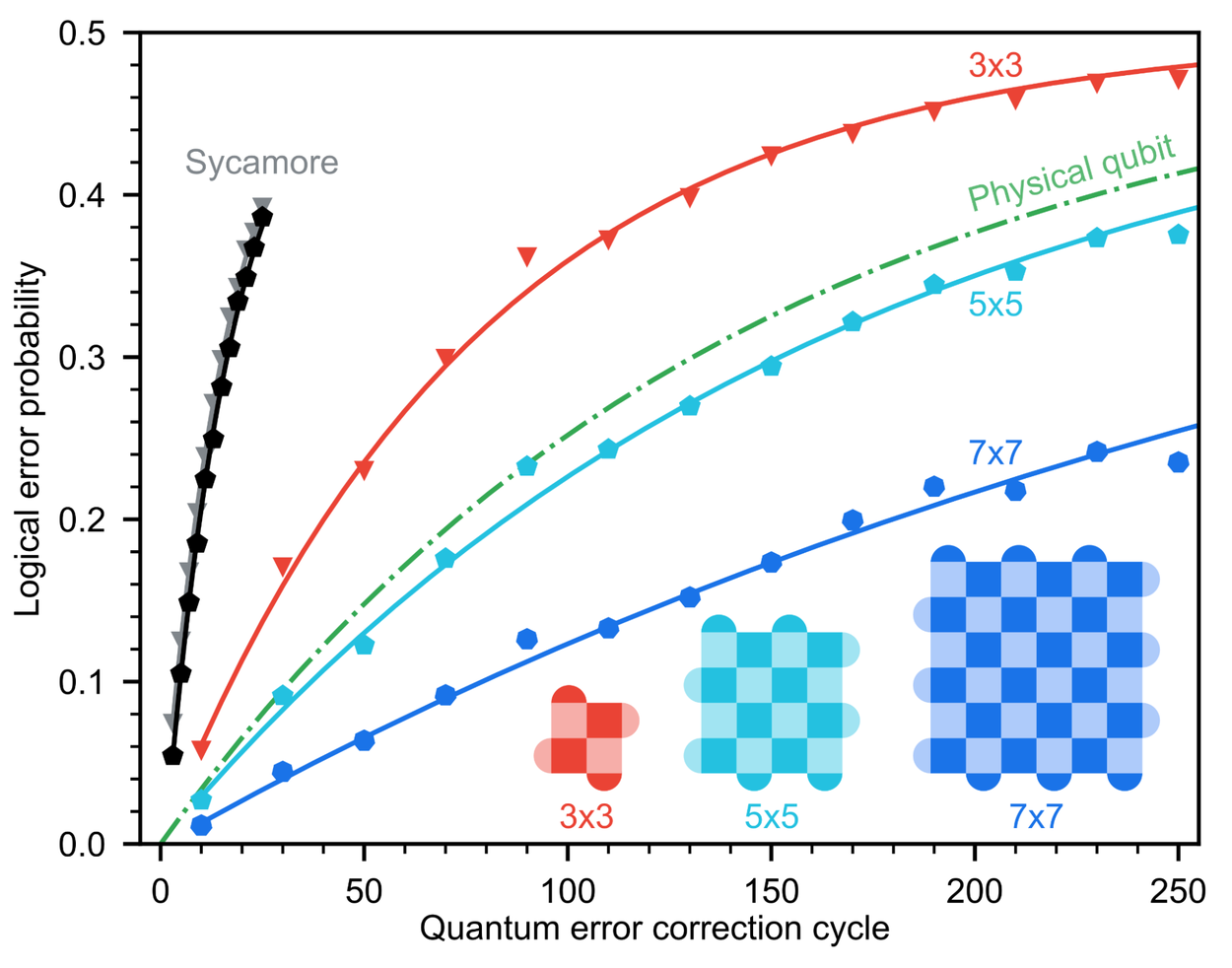
Figure: Scaling performance of the Willow processor across increasing surface code distances. Credit: Google Quantum AI / Research Blog
Hardware Improvements Over Sycamore
Willow represents a substantial hardware upgrade over Google's previous flagship processor, Sycamore, which in 2019 was used to claim quantum supremacy on a random circuit sampling benchmark. Key improvements include:
| Parameter | Sycamore (2019) | Willow (2024) |
|---|---|---|
| Qubit count | 53–70 | 105 |
| Average T₁ (qubit lifetime) | ~20 µs | ~68–100 µs |
| Gate fidelity | ~99% | >99.7% (two-qubit) |
| Real-time decoding | No | Yes (~63 µs latency) |
The near-fivefold improvement in qubit lifetime (T₁) was critical. Longer-lived qubits mean errors accumulate more slowly, giving the correction system time to detect and fix them. Willow also demonstrated real-time error correction, where measurement results from the physical qubits were processed by a decoder in approximately 63 microseconds — fast enough to keep pace with the error accumulation rate.
Beyond Breakeven
In addition to below-threshold scaling, the Willow team reported achieving "beyond breakeven" performance. This means the error-corrected logical qubit array maintained its quantum state for longer than any individual physical qubit within it. In other words, the error correction process was not merely keeping up with errors — it was actively improving the system's coherence beyond what the raw hardware could achieve alone.
Random Circuit Sampling Benchmark
Alongside the error correction experiments, Google used Willow to execute a Random Circuit Sampling (RCS) benchmark — the same type of computation used in the 2019 Sycamore experiment. Willow completed the task in under five minutes. Google estimated that the same calculation would take the world's fastest classical supercomputer approximately 10 septillion (10²⁵) years, a figure that exceeds the age of the universe by many orders of magnitude.
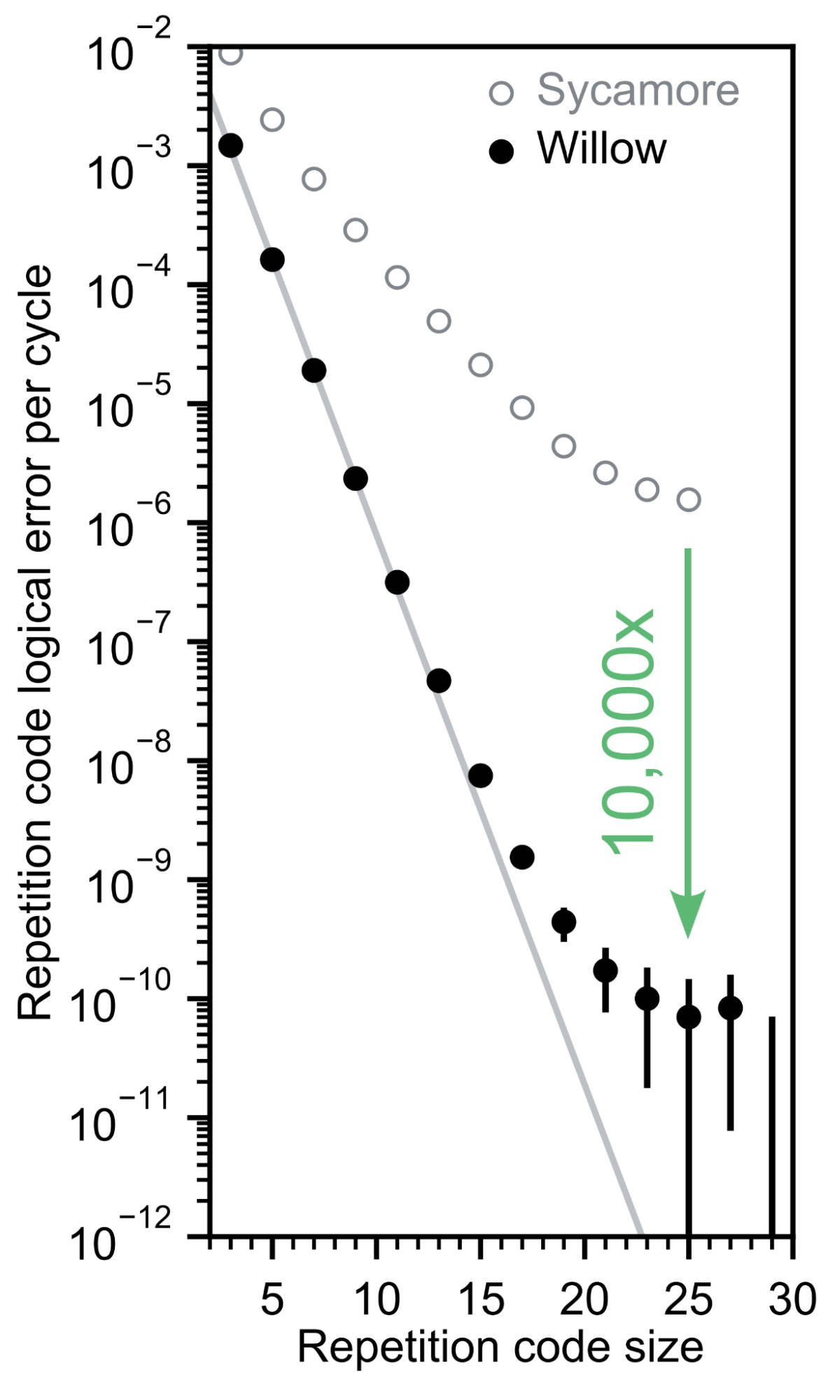
Figure: Willow benchmark performance versus classical supercomputer estimates. Credit: Google Quantum AI / Research Blog
While the RCS benchmark does not have direct practical applications, it serves as a standardised test of quantum computational advantage. The result reinforces that quantum processors are operating in a regime inaccessible to classical computation, even as classical algorithms and hardware continue to improve.
Scientific Reception and Caveats
The Willow results were widely celebrated as a historic first, but independent researchers noted important qualifications. The logical error rates achieved — approximately 0.14% per correction cycle — remain orders of magnitude higher than the ~10⁻⁶ levels required for large-scale, fault-tolerant quantum algorithms. Reaching those rates would require scaling to code distances of 15 or higher, encoding each logical qubit across hundreds or thousands of physical qubits.
Experts also cautioned that practical applications — such as simulating complex molecular systems for drug discovery, optimising supply chains, or breaking RSA encryption — remain years away. Current estimates suggest that useful fault-tolerant quantum computing may require at least another decade of development, involving not just better qubits but advances in decoder efficiency, control electronics, and cryogenic infrastructure.
The Road Ahead
Google Quantum AI has stated its goal of building a useful, fault-tolerant quantum computer by the end of the decade. The Willow result is a necessary step on that path — proof that the fundamental physics of error correction works as theory predicts. But it is not sufficient. The next milestones will involve scaling to larger code distances, demonstrating logical qubits with error rates low enough for multi-qubit logical gates, and eventually connecting multiple logical qubits into circuits capable of running useful algorithms.
IBM, Google's primary competitor in superconducting quantum computing, is pursuing a parallel but distinct strategy. IBM's Heron processor family and its roadmap toward the Starling fault-tolerant system by 2029 represent an alternative architectural approach. The competition between these strategies — and between superconducting platforms and alternative modalities such as trapped ions and neutral atoms — will shape the trajectory of the field over the coming years.
For now, Willow stands as a proof point that the quantum community has been waiting for: the threshold is real, it is reachable, and crossing it opens a path — however long — toward machines that can solve problems no classical computer ever will.
Sources
- Google Research Blog, "Quantum error correction below the surface code threshold," 9 December 2024 —
- Google Blog, "Meet Willow, our state-of-the-art quantum chip," 9 December 2024 —
- Acharya, R., et al., "Quantum error correction below the surface code threshold," Nature 638, 920–926 (2025) —
- Wikipedia, "Willow processor" —
- Google Quantum AI, Willow specification sheet —
FIRAT Editorial Board
Institutional Research Desk · Foresight Institute of Research and Translation
The collective editorial and research translation board of FIRAT, synthesising peer-reviewed evidence, policy briefs, and division milestones across our seven foundational research pillars.


