
Houston, Texas – August 25, 2026
NASA astronaut Anil Menon and European Space Agency astronaut Sophie Adenot completed the installation of a critical high-speed communications antenna outside the International Space Station on August 25, 2026, restoring a primary data link between the orbital laboratory and the ground.
The duo concluded their extravehicular activity at 2:57 p.m. EDT after 6 hours and 30 minutes outside the station. During the spacewalk — designated U.S. EVA 98 — they installed and connected a spare Space-to-Ground antenna, then secured the failed unit that had been removed and temporarily stowed on August 18 to a spare-parts platform on the station's truss.
Initial checkouts showed good power and data transmission, NASA said. Flight controllers in Houston will continue overnight testing to confirm full functionality.
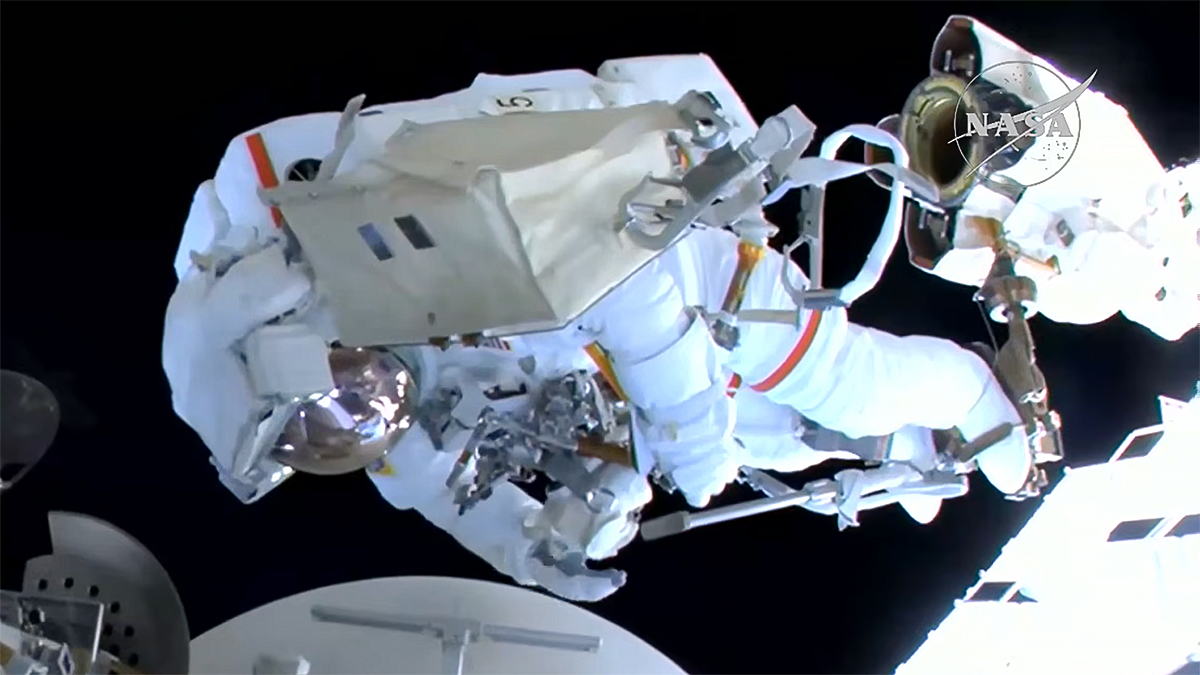
A Robotic Arm Assist at 260 Miles Up
Menon rode the Canadarm2 robotic arm as it maneuvered him to the worksite, where he and Adenot worked together to bolt, cable and mate the antenna. The Space-to-Ground antenna is the station's high-rate link that funnels telemetry, science data, video and voice between the complex and NASA's Mission Control Center in Houston.
When the primary antenna fails, data must be rerouted through backup systems at lower rates, constraining science downlink and operations. Replacing it returns the station to its nominal communications architecture ahead of a busy late-August schedule that includes the Nancy Grace Roman Space Telescope launch preparations and ongoing Expedition 75 research.
Two Spacewalks, One Fix
The August 25 EVA completed work begun on August 18, when the same crew removed the degraded antenna and stowed it temporarily. Mission managers split the task across two outings to manage timeline and thermal constraints, a standard approach for external communications hardware mounted on the station's truss.
NASA's live coverage noted that ground teams saw nominal voltage and signal lock shortly after Menon and Adenot mated the connectors, indicating the new unit is properly seated and powered.
Adenot, representing ESA, becomes one of the few European astronauts to log multiple ISS spacewalks in a single expedition, underscoring the agency's growing EVA experience as it prepares for future lunar surface operations under Artemis.
"Initial checkouts of the newly installed antenna showed good power and data transmission. Flight controllers on the ground will continue testing the antenna overnight to ensure full functionality." — NASA Space Station Blog, August 25, 2026, by Mark Garcia
Why High-Speed Links Matter
The ISS generates terabytes of data weekly — from protein crystallization and plant biology to Earth observation and technology demonstrations. High-speed Space-to-Ground links allow near-real-time downlink of high-definition video, high-rate telemetry and large experiment files, which in turn lets principal investigators on the ground adjust protocols during the mission rather than waiting for post-flight analysis.
The upgrade also matters for workforce development. Expedition 75 has balanced maintenance with research into the circulatory system, artificial intelligence applications and materials science. Reliable comms reduce the time crew members spend troubleshooting and increase the time available for science.
Countdown to Roman and Beyond
The spacewalk comes five days before the scheduled launch of NASA's Nancy Grace Roman Space Telescope on August 30, 2026, at 07:26 a.m. EDT from Kennedy Space Center's Launch Complex 39A aboard a SpaceX Falcon Heavy. Teams completed a flight readiness review on August 21 and enclosed the observatory in its fairing on August 24.
While unrelated to Roman, the timing highlights the cadence of concurrent human and robotic operations — from low-Earth-orbit maintenance to deep-space observatory deployment — that NASA is managing this month.
The next ISS spacewalk is already being prepared for early September, NASA said. Expedition 75 will continue overnight checkout of the antenna and will wrap the third August EVA with a post-spacewalk conference and suit servicing.
Source: NASA Space Station Blog, August 25, 2026, Mark Garcia — NASA, ESA Spacewalkers Finish Installing High-Speed Antenna. NASA Mission Control Houston. NASA/ESA Expedition 75.
FIRAT Editorial Board
Institutional Research Desk · Foresight Institute of Research and Translation
The collective editorial and research translation board of FIRAT, synthesising peer-reviewed evidence, policy briefs, and division milestones across our seven foundational research pillars.


