
Pasadena, California, USA · 26 November 2018
Mars received its newest robotic resident on 26 November 2018, when NASA's Interior Exploration using Seismic Investigations, Geodesy and Heat Transport (InSight) lander successfully touched down on the Red Planet after an almost seven-month, 485-million-kilometre journey from Earth. The landing signal, confirming a completed landing sequence, was received at NASA's Jet Propulsion Laboratory (JPL) at 11:52 a.m. PST (2:52 p.m. EST; 19:52 UTC).
InSight landed near Mars' equator on the western side of a flat, smooth expanse of lava called Elysium Planitia — a site chosen not for its surface features but for its safety and suitability for the mission's unique subsurface instruments.
"Today, we successfully landed on Mars for the eighth time in human history. InSight will study the interior of Mars, and will teach us valuable science as we prepare to send astronauts to the Moon and later to Mars." — Jim Bridenstine, NASA Administrator
Seven Minutes of Terror
The spacecraft hit the Martian atmosphere at 12,300 mph (19,800 km/h). The entire sequence from atmospheric entry to touching down on the surface took only six and a half minutes — a period NASA engineers call the "seven minutes of terror." During that brief window, InSight had to autonomously perform dozens of operations flawlessly: atmospheric entry, parachute deployment, heat shield separation, radar-activated descent, and retrorocket-assisted touchdown.
"We hit the Martian atmosphere at 12,300 mph, and the whole sequence to touching down on the surface took only six-and-a-half minutes. During that short span of time, InSight had to autonomously perform dozens of operations and do them flawlessly — and by all indications that is exactly what our spacecraft did." — Tom Hoffman, InSight Project Manager, JPL
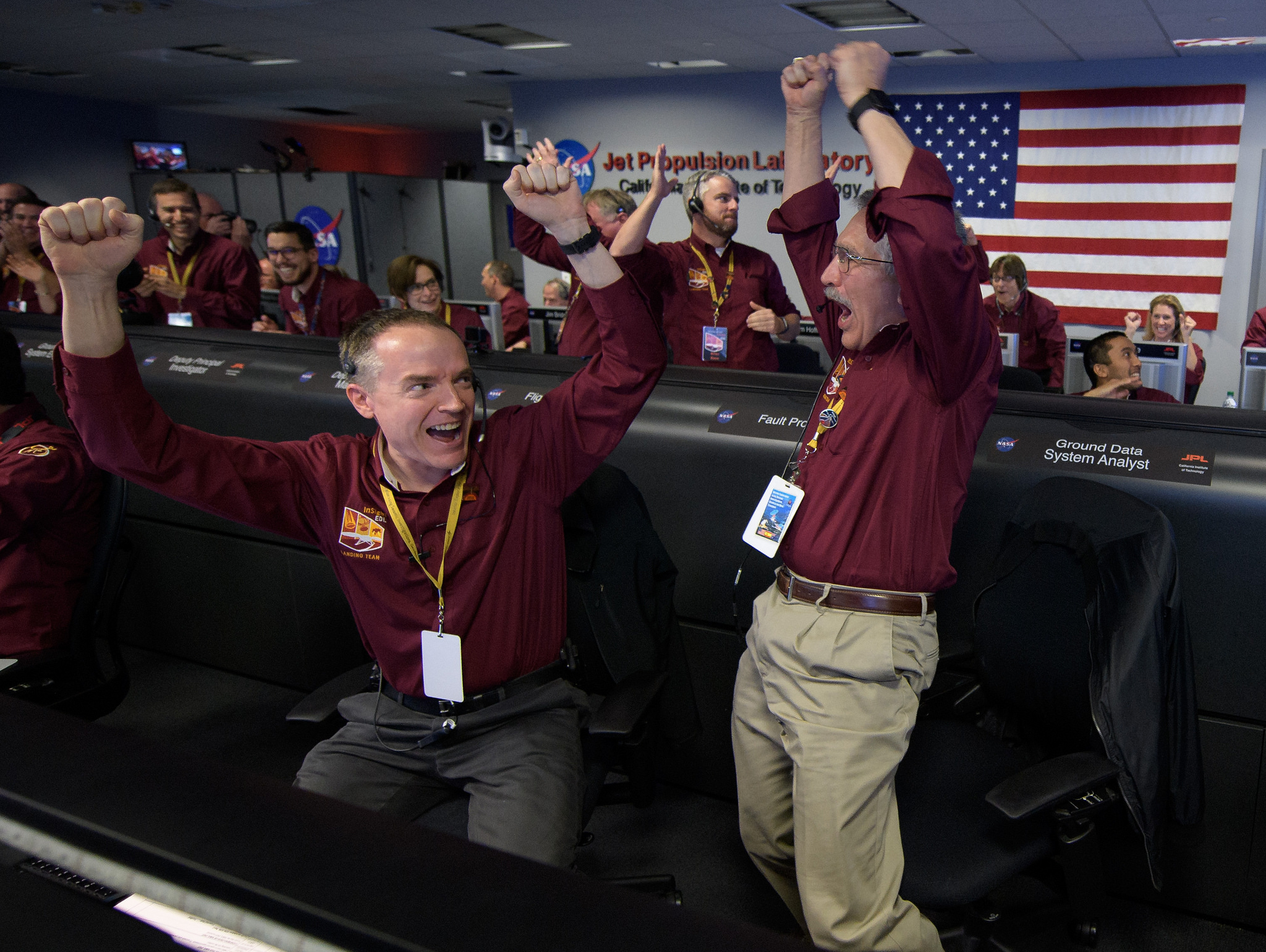
Mars InSight team members Kris Bruvold, left, and Sandy Krasner react after receiving confirmation that the Mars InSight lander successfully touched down on the surface of Mars, Monday, Nov. 26, 2018, inside the Mission Support Area at NASA's Jet Propulsion Laboratory in Pasadena, California. Credit: NASA/Bill Ingalls
MarCO: CubeSats in Deep Space
The landing signal was relayed to JPL via two experimental Mars Cube One (MarCO) CubeSats — briefcase-sized spacecraft that launched on the same rocket as InSight and followed the lander to Mars. They were the first CubeSats ever sent into deep space. After successfully carrying out communications and in-flight navigation experiments, the twin MarCOs were positioned to receive transmissions during InSight's entry, descent, and landing (EDL) sequence, providing near-real-time telemetry of the landing as it happened.
"That's one giant leap for our intrepid, briefcase-sized robotic explorers. I think CubeSats have a big future beyond Earth's orbit, and the MarCO team is happy to trailblaze the way." — Joel Krajewski, MarCO Project Manager, JPL
Without MarCO, the landing confirmation would have been delayed by several hours until it could be relayed through NASA's Mars Reconnaissance Orbiter (MRO), which was not in position for real-time reception.
A Mission Unlike Any Other
Unlike previous Mars missions that focused on surface geology, atmospheric chemistry, or the search for water and life, InSight was designed to answer a fundamentally different question: how did Mars — and by extension, all rocky planets — form and evolve?
InSight carried three principal instruments:
1. Seismic Experiment for Interior Structure (SEIS)
Provided by France's Centre National d'Études Spatiales (CNES) and the Institut de Physique du Globe de Paris (IPGP), with contributions from the Max Planck Institute for Solar System Research (Germany), the Swiss Institute of Technology (ETH Zurich), Imperial College and Oxford University (UK), and JPL, SEIS was a highly sensitive seismometer designed to detect marsquakes — seismic events caused by tectonic activity, meteorite impacts, and thermal stresses in the Martian crust.
By analysing how seismic waves travelled through Mars' interior, scientists could infer the thickness and density of the planet's crust, mantle, and core — the same technique used on Earth to map our planet's internal structure.
2. Heat Flow and Physical Properties Package (HP³)
Provided by the German Aerospace Center (DLR), with contributions from the Space Research Center (CBK) of the Polish Academy of Sciences and Astronika in Poland, HP³ was a self-hammering probe — nicknamed the "Mole" — designed to burrow up to 5 metres below the Martian surface to measure the heat flowing from the planet's interior. This heat flow measurement would constrain the amount of heat-producing radioactive elements in Mars' interior and provide insights into the planet's thermal evolution.
3. Rotation and Interior Structure Experiment (RISE)
RISE used the lander's X-band radio communications with Earth to precisely track Mars' rotational wobble (nutation) over the course of the mission. The amplitude of this wobble depends on the size and state of Mars' core — whether it is liquid or solid — providing a third independent constraint on the planet's internal structure.
International Partnership
InSight was part of NASA's Discovery Program, managed by the agency's Marshall Space Flight Center in Huntsville, Alabama. The spacecraft was built by Lockheed Martin Space in Denver, which also supported spacecraft operations. JPL managed the mission for NASA's Science Mission Directorate.
European partners played essential roles. France provided the SEIS seismometer, Germany provided the HP³ heat probe, and Spain's Centro de Astrobiología (CAB) supplied the wind sensors. The mission represented a model of international cooperation in planetary science.
Deployment Challenges
After landing, InSight's 1.8-metre robotic arm was used to carefully place SEIS and HP³ on the Martian surface — a process that took several weeks. The SEIS seismometer was covered with a wind and thermal shield (WTS) to protect it from the harsh Martian environment, where daily temperature swings of more than 100°C could introduce noise into the measurements.
The HP³ Mole, however, encountered unexpected difficulties. The probe was designed to penetrate the regolith through a combination of hammering and friction, but the soil at the landing site proved more cohesive than expected, lacking the friction needed for the Mole to gain traction. Despite extensive troubleshooting efforts by DLR and JPL engineers — including using the robotic arm to press down on the Mole — the probe was unable to reach its target depth of 5 metres. In January 2021, NASA announced that the HP³ heat probe effort would be concluded, though SEIS continued operating successfully.
Scientific Legacy
Despite the HP³ setback, InSight's seismic experiment was a resounding success. SEIS detected its first likely marsquake on 6 April 2019, and over the course of the mission recorded more than 1,300 seismic events. In July 2021, the InSight team confirmed the detection of a marsquake with a magnitude of approximately 5.0 — the largest seismic event ever recorded on another planet — which produced waves that travelled through the planet's core for the first time, enabling scientists to directly measure the size of Mars' core.
InSight operated on the Martian surface until its mission officially ended on 15 December 2022, when dust accumulation on its solar panels caused the lander to lose power. Over its four-year mission, InSight transformed our understanding of Mars' internal structure, revealing a crust thickness of 24–72 kilometres, a large liquid core with a radius of approximately 1,830 kilometres, and a mantle that extended farther than previously thought.
Sources
- NASA Press Release 18-104, "NASA InSight Lander Arrives on Martian Surface to Learn What Lies Beneath," 26 November 2018 —
- NASA Science Mission Directorate, InSight mission page —
- DLR, InSight mission profile —
- Banerdt, W.B. et al., "Initial results from the InSight mission on Mars," Nature Geoscience 13, 117–130 (2020)
- Stähler, S.C. et al., "Seismic detection of the Martian core," Science 373, 443–448 (2021)
FIRAT Editorial Board
Institutional Research Desk · Foresight Institute of Research and Translation
The collective editorial and research translation board of FIRAT, synthesising peer-reviewed evidence, policy briefs, and division milestones across our seven foundational research pillars.


