
Geneva, Switzerland — 17 July 2019
The World Health Organization Director-General, Dr. Tedros Adhanom Ghebreyesus, declared the Ebola outbreak in the Democratic Republic of the Congo (DRC) a Public Health Emergency of International Concern (PHEIC) on 17 July 2019. The declaration, made under the International Health Regulations (IHR), came after the fourth convening of the WHO Emergency Committee for this outbreak and was driven primarily by the confirmation of an Ebola case in Goma — a city of approximately two million inhabitants on the border with Rwanda.
"It is time for the world to take notice and redouble our efforts," said Dr. Tedros at a media briefing in Geneva. "We need to work together in solidarity with the DRC to end this outbreak and build a better health system. Extraordinary work has been done for almost a year under the most difficult circumstances. We all owe it to these responders — coming from not just WHO but also government, partners and communities — to shoulder more of the burden."
The Goma Case: A Turning Point
The decision to declare a PHEIC was catalysed by the confirmation of an Ebola case in Goma on 14 July 2019. The case was a pastor who had travelled to the city from Beni by bus, visiting a local health centre on arrival where the alert was raised. He was transferred the same day to the Ebola Treatment Centre (ETC) in Goma and died while being transferred to the ETC in Butembo. The case's full travel history was known, and all contacts were identified and followed up. Vaccination of his contacts, and contacts of contacts, in Goma commenced on 15 July 2019.
The confirmation of a case in Goma had been long anticipated by response teams. Preparation activities — including the vaccination of health workers, intensive training in infection prevention and control, and heightened surveillance — had been ongoing for more than six months. Neighbouring Rwanda was also conducting preparedness activities.
Four Emergency Committee Meetings
The 17 July declaration followed three previous Emergency Committee meetings that had each declined to recommend a PHEIC designation. The earlier meetings were held in October 2018, April 2019, and June 2019 — the last of which came after imported cases were detected in Uganda. On this fourth occasion, the Emergency Committee, chaired by Professor Robert Steffen, recommended the PHEIC designation, which the Director-General accepted.
Professor Steffen stated at the media briefing that the outbreak was still viewed as a regional rather than a global threat, but that experts were concerned about the recent spread to Goma, the recurrence of transmission in the former epicentre of Beni, and increasingly violent attacks against responders.
A Complex Emergency Environment
The outbreak, which began in August 2018 in North Kivu province, had been characterised as a "perfect storm" due to the combination of the deadly virus and ongoing military conflict in the region. The security situation was marked by the resurgence of activities from non-state armed groups in all three major areas of operations — Butembo, Beni, and Mangina. In the week preceding the declaration, two DRC nationals involved in the response — a community leader and a local volunteer — were killed in separate incidents in Beni.
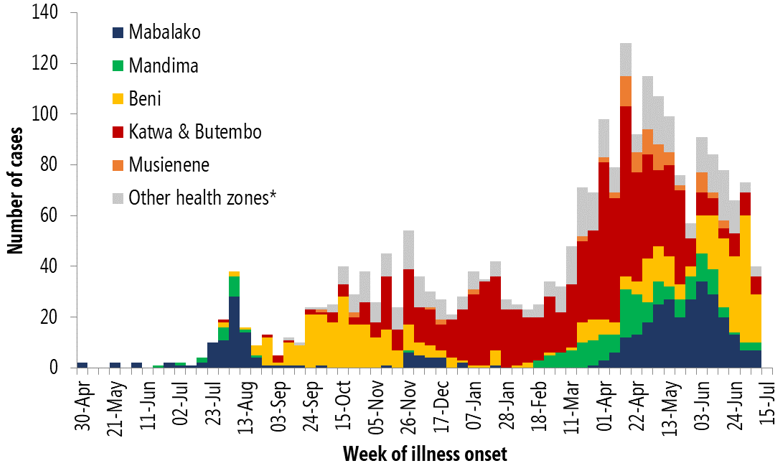
Figure: Confirmed and probable Ebola virus disease cases by week of illness onset by health zone. Data as of 16 July 2019. Credit: WHO
In the 21 days from 26 June through 16 July 2019, 67 health areas within 20 health zones reported new cases — representing 10% of the 664 health areas within North Kivu and Ituri provinces. During this period, 245 confirmed cases were reported, with the majority from Beni (50%, n=123), Mabalako (15%, n=37), Katwa (7%, n=18), Mandima (4%, n=10), and Butembo (4%, n=9).
Vaccine Supply Concerns
At the media briefing, WHO officials also addressed questions about the DRC's decision not to allow the use and testing of a second Ebola vaccine — the Johnson & Johnson Ad26.ZEBOV/MVA-BN candidate — which had been recommended by a WHO vaccine advisory group in April as a way to increase supply and test the effectiveness of a second vaccine.
DRC Health Minister Oly Ilunga Kalenga had expressed concerns that introducing a second vaccine might upset the population and complicate messaging, and that the Johnson & Johnson vaccine, which requires a second dose two months later, would present logistical challenges.
Dr. Mike Ryan, WHO's executive director of emergency programmes, acknowledged serious concerns about the supply of the currently used VSV-EBOV vaccine and said talks were under way to speed its availability, including having the manufacturer boost production or contracting with other companies. Earlier in the outbreak, health officials had switched to a dose-sparing approach to conserve the vaccine supply.
Cross-Border Concerns
The declaration also followed reports of a DRC woman — a fishmonger from Beni — who had travelled to a fish market in the Kasese district of Mpondwe, Uganda, one of the busiest border crossings between the DRC and Uganda. According to investigations, the woman had symptoms when she arrived and had four vomiting episodes at a food vending location in the market. She returned to Beni, where she was admitted to the Ebola treatment centre and subsequently died on 15 July after testing positive for Ebola. She had not used the formal border entry point, where she would have been screened.
Both Ugandan and DRC authorities were closely following potentially exposed contacts. No confirmed cases of Ebola were reported outside the DRC at the time of the declaration.
Funding and Response Costs
Dr. Ryan estimated that the cost for core operations over the next six months would exceed $233 million. The Emergency Committee expressed disappointment about delays in funding that had limited the response, particularly efforts to prepare other provinces and countries to detect and prevent the spread of Ebola. Dr. Tedros stated that the PHEIC declaration was not made for fundraising reasons, and that he was not aware of any donor countries withholding support without a formal declaration.
The WHO's risk assessment concluded that national and regional risk levels remained very high, while global risk levels remained low. Factors increasing the likelihood of further transmission chains included the high proportion of community deaths among confirmed cases, the relatively low proportion of new cases who were known contacts under surveillance, the existence of transmission chains linked to nosocomial infection, and persistent delays in detection and isolation.
Sources
- WHO Disease Outbreak News: Ebola virus disease — Democratic Republic of the Congo, 18 July 2019.
- WHO Statement: Ebola outbreak in the DRC declared a Public Health Emergency of International Concern, 17 July 2019.
- CIDRAP: WHO declares public health emergency over DRC Ebola, 17 July 2019.
- WHO Director-General's speech: IHR Emergency Committee on EVD-DRC North Kivu, 17 July 2019.
- European Centre for Disease Prevention and Control: WHO declares Ebola outbreak in DRC and Uganda a PHEIC.
FIRAT Editorial Board
Institutional Research Desk · Foresight Institute of Research and Translation
The collective editorial and research translation board of FIRAT, synthesising peer-reviewed evidence, policy briefs, and division milestones across our seven foundational research pillars.


