
Stockholm, Sweden · 8–9 October 2024 — In a pair of announcements that underscored the transformative role of artificial intelligence in modern science, the Royal Swedish Academy of Sciences awarded the 2024 Nobel Prize in Physics to John J. Hopfield and Geoffrey E. Hinton "for foundational discoveries and inventions that enable machine learning with artificial neural networks," and the Nobel Prize in Chemistry to David Baker, Demis Hassabis, and John M. Jumper for computational protein design and protein structure prediction. The back-to-back awards represented the first time the Nobel Committee explicitly recognised AI and machine learning as foundational scientific contributions.
Physics Prize: The Foundations of Machine Learning
On 8 October 2024, the Nobel Committee for Physics announced that the 11 million Swedish kronor prize would be shared equally between Hopfield, a professor at Princeton University, and Hinton, a professor at the University of Toronto. The citation honoured work spanning more than four decades that laid the theoretical and practical groundwork for the deep learning revolution.
John Hopfield created the Hopfield network in 1982 — an associative memory model that can store and reconstruct patterns from incomplete or distorted inputs. The network draws on the physics of magnetic spin systems: each node in the network is analogous to an atomic spin, and the network's overall state is described by an energy function, similar to the energy landscape of a spin glass in condensed matter physics. When fed a corrupted image, the network iteratively updates its nodes to minimise energy, converging on the stored pattern that most closely matches the input.
Geoffrey Hinton, often called the "godfather of AI," built upon Hopfield's framework to develop the Boltzmann machine in the mid-1980s. The Boltzmann machine uses principles from statistical physics — specifically the Boltzmann distribution — to learn probabilistic relationships in data. Hinton's subsequent work on backpropagation algorithms and deep belief networks in the 2000s was instrumental in launching the deep learning era, culminating in the neural network architectures that power today's image recognition, natural language processing, and generative AI systems.
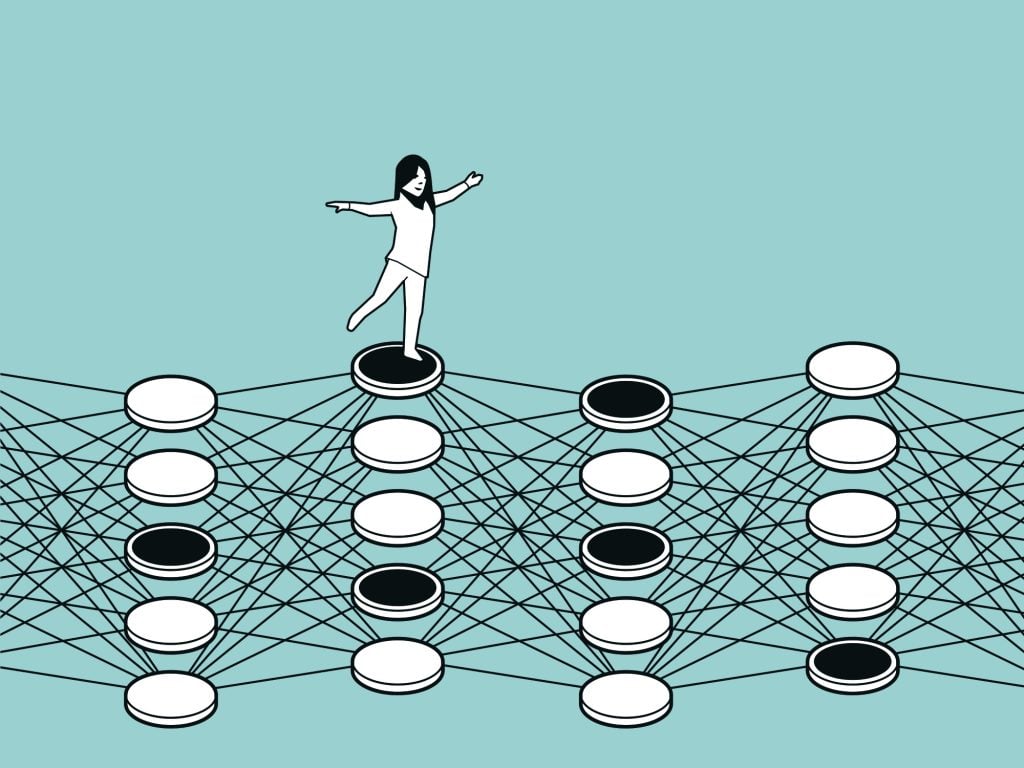
Illustration accompanying the Nobel Prize in Physics 2024 announcement. Credit: © Johan Jarnestad / The Royal Swedish Academy of Sciences
Ellen Moons, Chair of the Nobel Committee for Physics, stated at the announcement: "The laureates' work has already been of the greatest benefit. In physics we use artificial neural networks in a vast range of areas, such as developing new materials with specific properties."
Chemistry Prize: Cracking the Protein Folding Code
On 9 October 2024, the Nobel Committee for Chemistry announced that the prize would be divided: one half to David Baker of the University of Washington and the Howard Hughes Medical Institute "for computational protein design," and the other half jointly to Demis Hassabis and John Jumper of Google DeepMind "for protein structure prediction."
The two discoveries address complementary halves of one of biology's most enduring challenges: understanding the relationship between a protein's amino acid sequence and its three-dimensional structure. Proteins are life's molecular machines — they catalyse chemical reactions, transport molecules, provide structural support, and mediate immune responses. A protein's function is determined entirely by its shape, which is dictated by the folding of its amino acid chain. But predicting that shape from the sequence alone was a problem that had stymied biologists since the 1970s.
David Baker: Designing New Proteins
In 2003, Baker's research group achieved what the Nobel Committee described as an "almost impossible" feat: using computational methods to design an entirely new protein — called Top7 — that folded into a stable three-dimensional structure unlike any protein found in nature. Baker's software, Rosetta, models the physical forces that drive protein folding and allows researchers to specify a desired structure, then work backwards to find an amino acid sequence that will fold into it.
Since that initial breakthrough, Baker's laboratory has produced a stream of novel proteins with potential applications as pharmaceuticals, vaccines, nanomaterials, and biosensors. His work demonstrated that proteins are not limited to what evolution has produced — they can be engineered from scratch with functions nature never explored.
Hassabis and Jumper: AlphaFold2
The second half of the Chemistry Prize recognised the development of AlphaFold2, an AI system created by Google DeepMind that solved the 50-year-old protein structure prediction problem. In 2020, AlphaFold2 demonstrated at the Critical Assessment of Protein Structure Prediction (CASP14) competition that it could predict protein structures with accuracy comparable to experimental methods such as X-ray crystallography — a result that stunned the structural biology community.
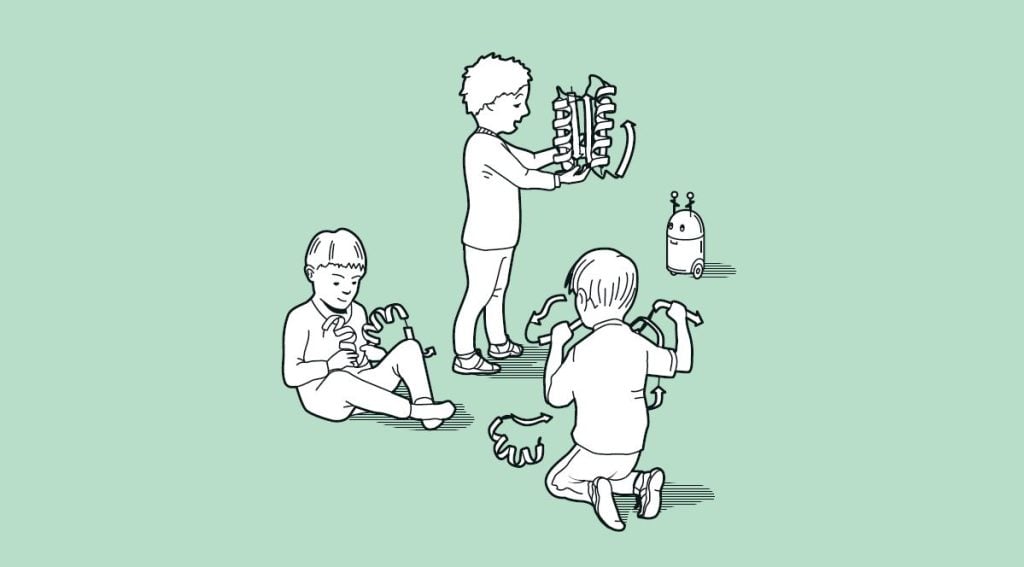
Illustration accompanying the Nobel Prize in Chemistry 2024 announcement. Credit: © The Royal Swedish Academy of Sciences
Heiner Linke, Chair of the Nobel Committee for Chemistry, said at the announcement: "One of the discoveries being recognised this year concerns the construction of spectacular proteins. The other is about fulfilling a 50-year-old dream: predicting protein structures from their amino acid sequences. Both of these discoveries open up vast possibilities."
The Significance of AI in Both Prizes
The decision to award both the Physics and Chemistry prizes for AI-related work in the same year was widely interpreted as a signal from the Nobel Committee that artificial intelligence has crossed a threshold from an engineering discipline to a foundational science with broad implications across fields.
In physics, the Hopfield network and Boltzmann machine demonstrated that tools from statistical and condensed matter physics could be repurposed to build learning systems. The connection between physics and machine learning runs deep: the energy minimisation principles underlying Hopfield networks are the same principles that govern magnetic materials, and the probabilistic sampling at the heart of the Boltzmann machine mirrors the statistical mechanics of thermal systems.
In chemistry, AlphaFold2's success illustrated that AI could solve problems where traditional computational approaches — even decades of effort using molecular dynamics and physics-based simulations — had stalled. The protein folding problem was considered one of the grand challenges of computational biology. Its resolution by a deep learning system demonstrated that AI can discover patterns and relationships in biological data that are too complex for human-designed algorithms to capture.
The Laureates
| Prize | Laureate | Affiliation | Born |
|---|---|---|---|
| Physics | John J. Hopfield | Princeton University, USA | 1933, Chicago |
| Physics | Geoffrey E. Hinton | University of Toronto, Canada | 1947, London |
| Chemistry | David Baker | University of Washington / HHMI, USA | 1962, Seattle |
| Chemistry | Demis Hassabis | Google DeepMind, UK | 1976, London |
| Chemistry | John M. Jumper | Google DeepMind, UK | 1985, Little Rock, AR |
The prize amounts were 11 million Swedish kronor each (approximately $1 million USD), shared equally in Physics and split one-half/one-quarter/one-quarter in Chemistry.
Broader Context and Debate
The awards sparked discussion within the scientific community about the boundaries between disciplines. Some physicists argued that machine learning, while built on physics-inspired foundations, is more naturally a computer science or statistics contribution. Others welcomed the cross-disciplinary recognition, noting that the most transformative scientific advances often emerge at the intersection of fields.
Hinton himself, in interviews following the announcement, used the platform to voice concerns about the risks of advanced AI systems, warning that the technology he helped create could have consequences he did not fully anticipate. His remarks added a note of caution to what was otherwise a celebration of AI's scientific maturity.
The 2024 Nobel Prizes will likely be remembered as a turning point — the moment when the scientific establishment formally acknowledged that artificial intelligence belongs not at the periphery of science but at its core, as both a product of fundamental physics and an engine of discovery across chemistry, biology, and beyond.
Sources
- NobelPrize.org, "Press release: The Nobel Prize in Physics 2024" —
- NobelPrize.org, "Press release: The Nobel Prize in Chemistry 2024" —
- NobelPrize.org, "The Nobel Prize in Physics 2024 — Summary" —
- EMBL, "AlphaFold wins Nobel Prize in Chemistry 2024" —
- Wikipedia, "2024 Nobel Prizes" —
FIRAT Editorial Board
Institutional Research Desk · Foresight Institute of Research and Translation
The collective editorial and research translation board of FIRAT, synthesising peer-reviewed evidence, policy briefs, and division milestones across our seven foundational research pillars.


