
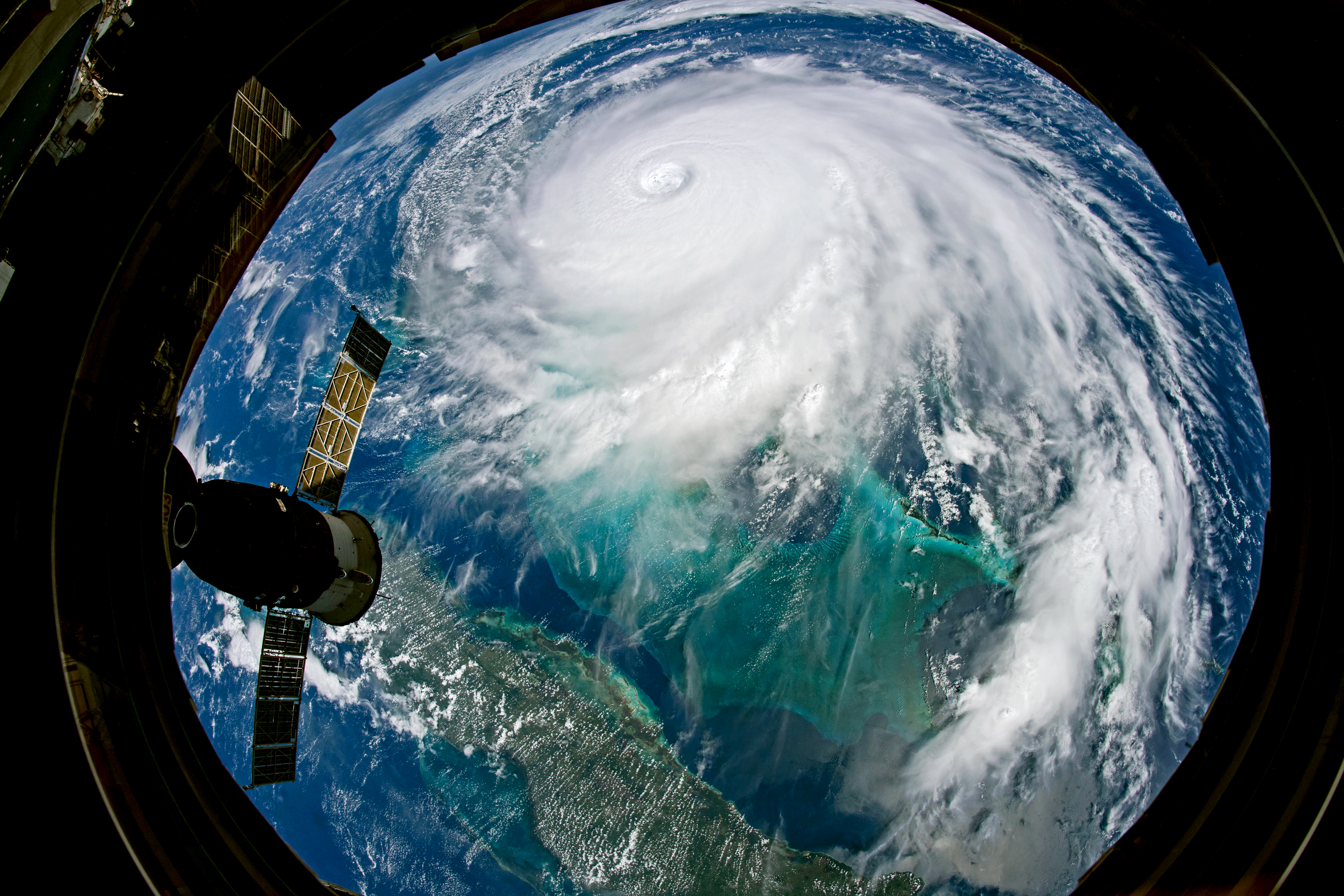
Marsh Harbour, Abaco Islands, Bahamas · 1–3 September 2019 — Hurricane Dorian struck the Abaco Islands of the Bahamas on 1 September 2019 with maximum sustained winds of 185 mph (295 km/h), tying the 1935 Labor Day hurricane for the strongest landfall winds ever recorded in the Atlantic basin. It then crawled westward to Grand Bahama, where it stalled for approximately 40 consecutive hours, unleashing catastrophic winds, a devastating storm surge, and rainfall estimated at up to 60 inches (150 cm). The result was the worst natural disaster in the Bahamas' recorded history: at least 70 confirmed deaths, 70,000 people left homeless, and US$3.4 billion in damage — roughly a quarter of the nation's GDP.
A Storm of Record-Breaking Intensity
Dorian originated from a tropical wave identified by the National Hurricane Center (NHC) over Guinea and Senegal on 19 August 2019. The system organised into Tropical Depression Five on 24 August and was named Dorian the following day. After crossing the Lesser Antilles and brushing the U.S. Virgin Islands as a Category 1 hurricane on 28 August, Dorian entered a period of rapid intensification over exceptionally warm waters.
By the morning of 1 September, a dropsonde deployed by a NOAA reconnaissance aircraft measured a surface wind gust of 203 mph (326 km/h). At 16:40 UTC that day, Dorian made landfall on Great Abaco Island at Elbow Cay with one-minute sustained winds of 185 mph (298 km/h), gusts exceeding 220 mph (355 km/h), and a minimum central pressure of 910 millibars — the fifth-lowest pressure recorded at Atlantic landfall.
The storm made a second landfall on Grand Bahama at 02:00 UTC on 2 September at near-identical intensity. With Dorian, 2019 became the fourth consecutive year to produce at least one Category 5 hurricane in the North Atlantic — an unprecedented streak in the historical record.
The 40-Hour Stall
What transformed Dorian from a severe hurricane into an unprecedented catastrophe was not its winds alone, but its speed — or lack of it. As Dorian approached Grand Bahama, the steering currents that had been pushing the storm westward at 10–15 mph collapsed. The Bermuda High, which had been guiding the system, weakened, leaving Dorian without a clear path forward.
The storm's forward speed slowed to just 1 mph — effectively stationary. For approximately 40 consecutive hours, portions of Dorian's eyewall battered Great Abaco Island and Grand Bahama with Category 5 conditions. The NHC reported the storm as "stationary" in its advisories. It was the longest duration a single land area had been subjected to Category 5 hurricane conditions in recorded Atlantic history.
NASA Earth Observatory captured the phenomenon in a dramatic visualisation combining IMERG rainfall data with GEOS-5 model wind fields, showing how rainfall rates surged precisely as the storm's forward motion collapsed on 2–3 September.
Devastation Across Abaco and Grand Bahama
The Abaco Islands bore the brunt of Dorian's initial landfall. Marsh Harbour, the largest settlement on Great Abaco, was largely obliterated. Aerial imagery showed entire neighbourhoods flattened, with structures swept from their foundations and debris fields stretching for miles. The shantytown settlements of The Mudd and Pigeon Peas — home to many Haitian-Bahamian communities — were among the hardest hit, with reports of near-total destruction.
On Grand Bahama, the prolonged stall produced a storm surge that inundated vast areas of Freeport and the surrounding communities. The International Federation of Red Cross and Red Crescent Societies reported that approximately 13,000 homes were destroyed or severely damaged. The Bahamas' National Emergency Management Agency (NEMA) confirmed that at least 70,000 people — roughly 17 percent of the country's population of approximately 400,000 — were left homeless.
| Impact Metric | Figure | Source |
|---|---|---|
| Maximum sustained winds at landfall | 185 mph (295 km/h) | NHC Tropical Cyclone Report |
| Minimum central pressure | 910 mbar | NHC |
| Duration of Category 5 conditions over land | ~22 hours (eyewall), ~40 hours stalled | NHC / NASA Earth Observatory |
| Estimated peak rainfall (Grand Bahama) | 60 inches (150 cm) | NASA IMERG |
| Confirmed deaths (Bahamas) | At least 70 (74 total direct) | NHC / IDB assessment |
| People left homeless | ~70,000 | NEMA / ReliefWeb |
| Homes destroyed or severely damaged | ~13,000 | IFRC |
| Damage in the Bahamas | US$3.4 billion | IDB / NHC |
| Total damage (all regions) | US$5.08 billion | NHC |
The death toll evolved over months. Initial official counts stood at 43, then rose to 67 confirmed by late October 2019 (56 on Abaco, 11 on Grand Bahama), according to an Inter-American Development Bank (IDB) assessment. The NHC's final tropical cyclone report recorded 74 direct deaths in the Bahamas, with 245 people still reported missing as of August 2020. The true death toll remains unknown.
The Climate Connection: Slower, Stronger, Wetter
Dorian's stall was not merely bad luck. Research published in 2019 by NASA Goddard Institute for Space Studies scientist Timothy Hall and NOAA atmospheric scientist James Kossin found that North Atlantic hurricanes have been moving more slowly and stalling more frequently over the past seven decades. Of the 66 storms that stalled in the North Atlantic basin between 1944 and 2017, nearly two-thirds did so within the most recent 25 years of that period.
"A storm that stalls means more extreme rain, more extreme winds, more extreme damage. Stalling over a populated area is the absolute last thing you want to see a hurricane do." — Timothy Hall, NASA Goddard Institute for Space Studies
Hall identified climate change as a possible driver of the stalling trend, though he cautioned that the connection between climate and stalling is less definitive than the evidence that warming is making hurricanes stronger and wetter. Warmer ocean temperatures provide more energy for intensification; a warmer atmosphere holds more moisture, increasing rainfall potential; and weakened atmospheric circulation may reduce the steering currents that move storms along.
Dorian itself underwent rapid intensification — strengthening from a Category 2 to a Category 5 hurricane in under 24 hours — a phenomenon that studies have shown is becoming more common in a warming climate. The storm also featured the highest sustained winds ever recorded at its latitude (26.6°N) and was the strongest Atlantic-basin hurricane ever detected outside the tropics.
Response and Recovery
The humanitarian response was immediate but overwhelmed by the scale of destruction. The Royal Bahamas Police Force and the Bahamas Defence Force conducted search-and-rescue operations, while international assistance flowed in from the United Nations, the Red Cross, the United States, the United Kingdom, and numerous NGOs. The IDB conducted a comprehensive damage and needs assessment, estimating recovery costs at US$3.4 billion for the Bahamas alone.
The storm also exposed vulnerabilities in disaster preparedness and climate resilience for small island developing states (SIDS). The Bahamas, despite having one of the highest per-capita incomes in the Caribbean, lacked the infrastructure to withstand a storm of Dorian's magnitude and duration. The disproportionate impact on informal settlements — particularly Haitian-Bahamian communities in Abaco — raised questions about equitable disaster response and the legal status of displaced migrant populations.
Due to the catastrophic damage and loss of life, the World Meteorological Organization retired the name Dorian from the Atlantic rotating naming lists in 2020. The name will never be used again for an Atlantic hurricane.
A Warning for the Warming Atlantic
Hurricane Dorian stands as a defining case study in the intersection of extreme weather intensity, storm behaviour, and climate change. It demonstrated that a hurricane's destructive potential is determined not only by its wind speed category, but by its duration over a location, its rainfall output, and the resilience of the communities in its path.
For the Bahamas, recovery continues years after the storm. For climate scientists, Dorian provided stark evidence that the most dangerous hurricanes of the future may not simply be stronger — they may also be slower, delivering prolonged devastation to whatever lies beneath their stalled eyewalls.
Sources
- National Hurricane Center (2020) Tropical Cyclone Report: Hurricane Dorian (AL052019). NOAA / NHC.
- NASA Earth Observatory (5 September 2019) A Devastating Stall by Hurricane Dorian.
- Hall, T.M. and Kossin, J.P. (2019) Hurricane stalling along the North American coast and implications for rainfall. npj Climate and Atmospheric Science, 2, 17.
- Inter-American Development Bank (2020) Assessment of the Effects and Impacts of Hurricane Dorian in The Bahamas.
- ReliefWeb / OCHA (6 September 2019) Hurricane Dorian — Bahamas: Humanitarian Situation Report No.1.
- International Federation of Red Cross and Red Crescent Societies (2019) Hurricane Dorian response.
- National Aeronautics and Space Administration (2019) NASA ARIA Team Maps Flooding in the Bahamas.
- Science News (3 September 2019) Hurricane Dorian's slow pace makes it dangerous and hard to predict.
FIRAT Editorial Board
Institutional Research Desk · Foresight Institute of Research and Translation
The collective editorial and research translation board of FIRAT, synthesising peer-reviewed evidence, policy briefs, and division milestones across our seven foundational research pillars.

