
Stockholm, Sweden · 1 October 2018
The Nobel Assembly at Karolinska Institutet has awarded the 2018 Nobel Prize in Physiology or Medicine jointly to James P. Allison of the University of Texas MD Anderson Cancer Center and Tasuku Honjo of Kyoto University, recognizing their discovery of cancer therapy by inhibition of negative immune regulation. The prize, announced at the Nobel Forum in Stockholm, carries an award of 9 million Swedish krona to be shared equally between the two laureates.
The Nobel Assembly cited the laureates for establishing "an entirely new principle for cancer therapy" by stimulating the inherent ability of the immune system to attack tumor cells. Their work on immune checkpoint proteins — molecular brakes that suppress T-cell activity — has transformed the treatment landscape for advanced cancers that were once considered essentially untreatable.
The Science of Immune Checkpoints
The human immune system's ability to distinguish "self" from "non-self" is fundamental to its defense against pathogens. T cells, a type of white blood cell, are key players in this process. T cells carry receptors that bind to structures recognized as foreign, triggering immune engagement. However, the system also includes proteins that function as brakes on T cells, preventing excessive activation that could lead to autoimmune destruction of healthy tissue.
Allison and Honjo independently discovered two different brake mechanisms — CTLA-4 and PD-1 — and demonstrated that blocking these brakes could unleash the immune system against cancer cells.
CTLA-4: Allison's Discovery
During the 1990s, working at the University of California, Berkeley, James P. Allison studied the T-cell protein CTLA-4. While other research teams explored the mechanism as a target for treating autoimmune disease, Allison had a different idea. He developed an antibody that could bind to CTLA-4 and block its function, then tested whether this blockade could disengage the T-cell brake and unleash the immune system against cancer.
Allison and his co-workers performed their first experiment at the end of 1994, and in their excitement immediately repeated it over the Christmas break. The results were spectacular: mice with cancer were cured by treatment with antibodies that inhibited the brake and unlocked antitumor T-cell activity. Despite little interest from the pharmaceutical industry, Allison continued developing the strategy into a therapy for humans. In 2010, a clinical study showed striking effects in patients with advanced melanoma, with several patients showing no remaining signs of cancer — results never before seen in this patient group.
PD-1: Honjo's Discovery
In 1992, a few years before Allison's CTLA-4 breakthrough, Tasuku Honjo discovered PD-1, a protein expressed on the surface of T cells. Through years of meticulous research at Kyoto University, Honjo revealed that PD-1 also functions as a T-cell brake, but operates through a different mechanism. Animal experiments confirmed that PD-1 blockade was a promising anticancer strategy.
Clinical development followed, and in 2012 a key study demonstrated clear efficacy across multiple cancer types. The results were dramatic, producing long-term remission and possible cure in patients with metastatic cancer — a condition previously considered essentially untreatable.
Clinical Impact and the Rise of Checkpoint Therapy
The clinical development following these discoveries has been dramatic. Immune checkpoint therapy has fundamentally changed outcomes for patients with advanced cancer. Of the two strategies, checkpoint therapy against PD-1 has proven more broadly effective, with positive results observed in lung cancer, renal cancer, lymphoma, and melanoma.
New clinical studies indicate that combination therapy — targeting both CTLA-4 and PD-1 simultaneously — can be even more effective, as demonstrated in patients with melanoma. A large number of checkpoint therapy trials are currently underway against most types of cancer, and new checkpoint proteins are being investigated as additional targets.
| Checkpoint | Discoverer | Year of Discovery | First Major Clinical Success | Key Cancer Types |
|---|---|---|---|---|
| CTLA-4 | James P. Allison | 1994 (preclinical) | 2010 (melanoma) | Melanoma |
| PD-1 | Tasuku Honjo | 1992 (identification) | 2012 (multiple types) | Lung, renal, lymphoma, melanoma |
A Century-Long Quest
For more than 100 years, scientists attempted to engage the immune system in the fight against cancer. In the late 19th century, researchers tried infecting patients with bacteria to activate immune defenses — efforts that had only modest effects. A variant of this strategy survives today in bladder cancer treatment. Despite remarkable progress in understanding fundamental immune mechanisms, attempts to develop generalizable new strategies against cancer proved difficult until the seminal discoveries by Allison and Honjo.
The Nobel Assembly noted that checkpoint therapy has "revolutionized cancer treatment and has fundamentally changed the way we view how cancer can be managed." Previous Nobel Prizes in cancer treatment have recognized hormone treatment for prostate cancer (Huggins, 1966), chemotherapy (Elion and Hitchings, 1988), and bone marrow transplantation for leukemia (Thomas, 1990).
The Laureates
James P. Allison was born in 1948 in Alice, Texas, USA. He received his PhD in 1973 at the University of Texas, Austin. He held faculty positions at the University of Texas System Cancer Center, the University of California, Berkeley, and Memorial Sloan-Kettering Cancer Center. Since 2012, he has been Professor at the University of Texas MD Anderson Cancer Center and is affiliated with the Parker Institute for Cancer Immunotherapy.
Tasuku Honjo was born in 1942 in Kyoto, Japan. He earned his MD in 1966 and his PhD in 1975 at Kyoto University. After research fellowships at the Carnegie Institution of Washington and the National Institutes of Health in the United States, he held faculty positions at Tokyo University and Osaka University. Since 1984, he has been Professor at Kyoto University.
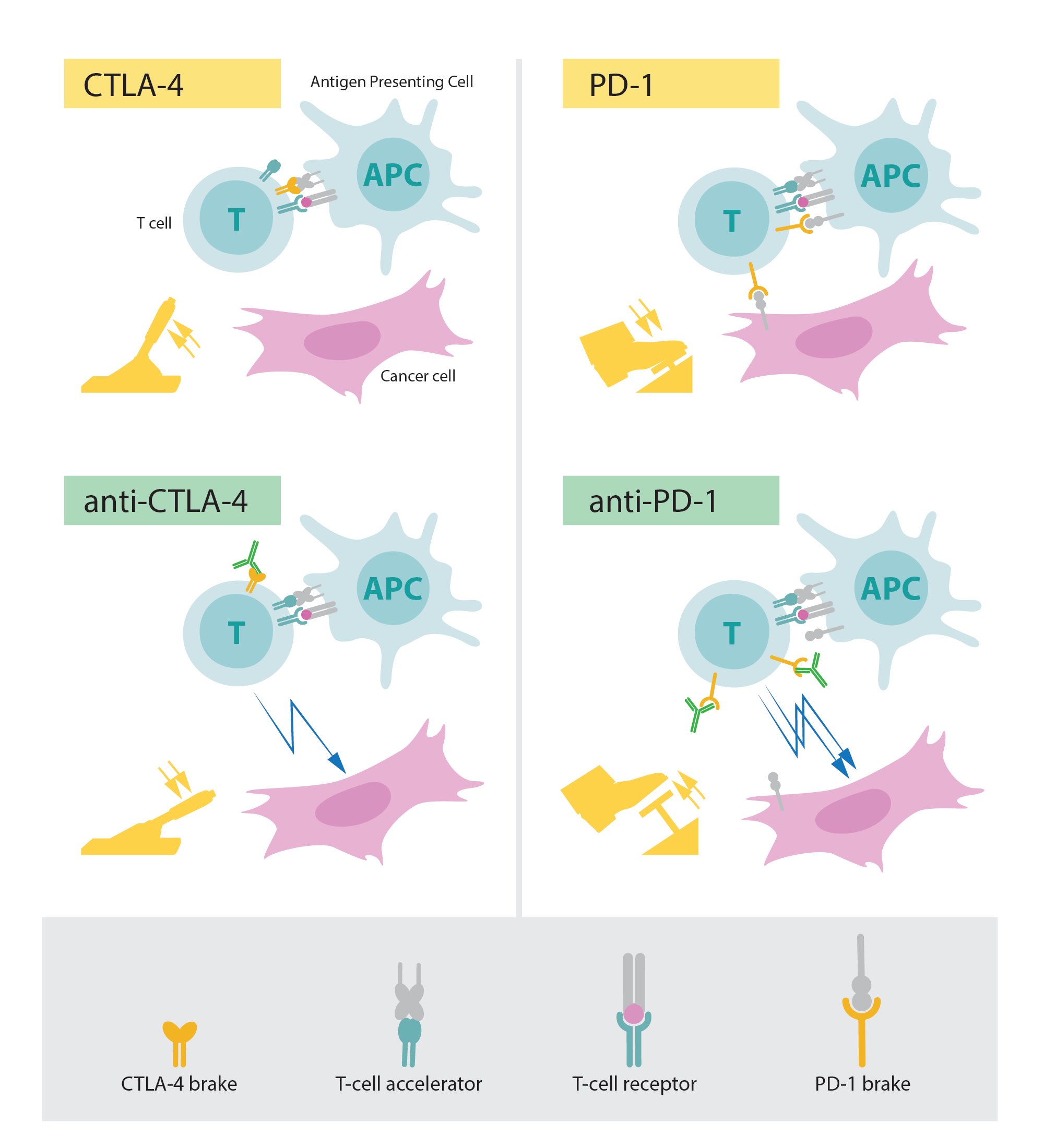
Figure: Upper left — T cell activation requires binding to non-self structures and accelerator proteins. CTLA-4 functions as a brake inhibiting the accelerator. Lower left — Antibodies (green) against CTLA-4 block the brake, leading to T-cell activation and cancer cell attack. Upper right — PD-1 is another T-cell brake. Lower right — Antibodies against PD-1 inhibit the brake, leading to highly efficient attack on cancer cells. © The Nobel Committee for Physiology or Medicine. Illustrator: Mattias Karlén
Sources
- Nobel Prize press release, NobelPrize.org (1 October 2018):
- Nobel Prize announcement:
- Cancer Research Institute analysis:
- Key publications: Ishida et al. (1992) EMBO J; Leach et al. (1996) Science; Nishimura et al. (1999) Immunity
FIRAT Editorial Board
Institutional Research Desk · Foresight Institute of Research and Translation
The collective editorial and research translation board of FIRAT, synthesising peer-reviewed evidence, policy briefs, and division milestones across our seven foundational research pillars.

